HOW IT WORKS
A voice as moving filters
A bank of filters splits speech into bands. The loudness in each band steers a matching filter on a buzzy, harmonic-rich tone, so the tone takes on the shape of the words.
Count the bands
HOW A SYNTH LEARNED TO TALK
VOICE encoder
AI-generated image, not a photograph of a real person or place.
The vocoder treats your voice as a set of moving filters.
It was built in the 1930s to save space on telephone lines, then kept wartime leaders' calls secret, then became the sound of every film robot. The trick behind all three is the same: measure speech in bands, then rebuild it.
THE SHORT ANSWER
One idea from 1928,
three very different lives.
HOW IT WORKS
A bank of filters splits speech into bands. The loudness in each band steers a matching filter on a buzzy, harmonic-rich tone, so the tone takes on the shape of the words.
Count the bandsWARTIME
From 1943 the SIGSALY system digitised and encrypted vocoder signals for the highest-level Allied calls. The Science Museum says no conversation is recorded as broken.
See the numbersMUSIC
The classic vocoder loses some pitch inflection and crisp consonants. That made it Hollywood's go-to sound for robots and talking computers, and a studio favourite from the 1970s.
The story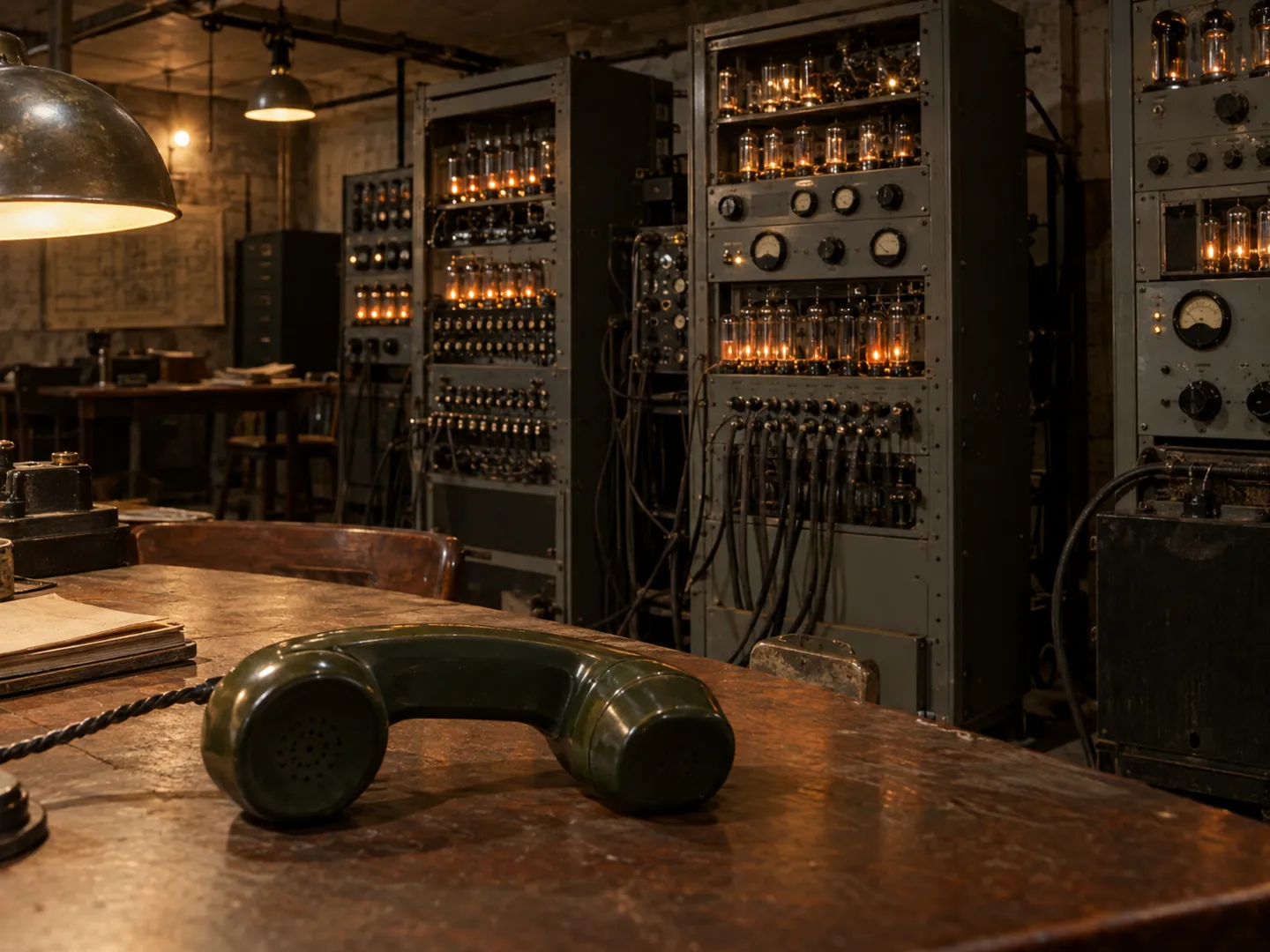
FOUR STAGES OF A VOCODER
A classic channel vocoder has an analysis half and a resynthesis half. In music, the synth you play becomes the voice's new raw sound.
Speech passes through a parallel bank of bandpass filters, each tuned to a slice of the speech range, from low to high.
An amplitude detector follows the loudness in each band and turns it into a slowly changing control signal.
Dudley used a buzzy oscillator rich in partials, standing in for the vibrating vocal folds. Musicians feed in a synth instead.
Each control signal opens a matching filter on the raw sound, so it takes on the moving shape of the original words.
TWO NUMBERS WORTH KNOWING
One figure on how little a vocoder sends,
one on what it took to keep it secret.
50 a second
Updates per second for intelligible speech
An early modified vocoder updated its control signals only 50 times a second and still produced understandable speech, which is why phone companies were so interested.
DATA · INDIANA UNIVERSITY
55 tons
Weight of the wartime secure phone
SIGSALY filled 2,500 square feet and needed 30,000 watts. Its London terminal sat in the basement of Selfridges because it was too big for Whitehall.
SIGSALY · SCIENCE MUSEUM
Each SIGSALY call was encrypted with random noise stored on a pair of phonograph records, one for each end, each holding 12 minutes of key. The system was in use until 1946.
COUNT THE BANDS
A channel vocoder splits speech into a number of bands, or channels. Pick a band count to see where it was used. The bar shows how much detail the vocoder can carry.
More bands and a wider frequency range give more accurate speech. Musicians chasing the classic effect usually stay at sixteen bands or fewer.
FROM BELL LABS TO THE STUDIO
Homer Dudley began studying how to imitate the vocal tract electronically at Bell Labs in 1928, and received vocoder patents in 1937 and 1939. His Voder, a keyboard-played speaking machine, was demonstrated at the 1939 World's Fair by operators trained for a year.
After the war, the US military used ever smaller vocoders for encrypted speech until the early 1960s. When affordable vocoders reached studios in the 1970s, musicians used them to make voices sing through synths. The Science Museum holds a UK kit-built vocoder used by an electro-acoustic musician.
In conversation
It is a contraction of voice encoder. Homer Dudley developed it at Bell Labs, receiving patents in 1937 and 1939.
It measures the loudness of speech in a set of frequency bands and uses those measurements to shape another sound, such as a synth. The classic design loses some pitch inflection and crisp consonants, which gives the robotic character.
Yes. The SIGSALY system, introduced in 1943, digitised and encrypted vocoder signals for top-level Allied calls, including between Churchill and Roosevelt. It weighed 55 tons.
Yes. Indiana University's music technology text notes that vocoder technology is still employed in digital forms of modern telephony, and vocoders remain available as audio plug-ins.
A speaking machine Dudley built using the resynthesis half of his vocoder, played by hand with ten keys, wrist bars and a foot pedal. It was shown at the 1939 World's Fair.
Each figure on this page comes from the sources below.
ABOUT THIS NAME
doodlesynthesizer.com is part of the DoodleSale portfolio. It isn't in an auction right now, but you can ask about leasing it.